
Capital that reaches further
George Karamitsos, Vice President of Sustainable Finance, and Simone-Louise Hutchings, Executive Vice President of Sustainable Finance at Standard Bank, worked with JUMO to develop a Social Finance Framework designed to connect institutional capital with financial inclusion at scale. Here, they explain why the Framework matters, what it offers investors and how it can help more underserved individuals and businesses across Africa access responsible financial services.
Pull quote: ‘The Social Finance Framework creates a credible bridge between pools of institutional capital and millions of people and businesses whose economic potential has been constrained by limited access to formal finance.’
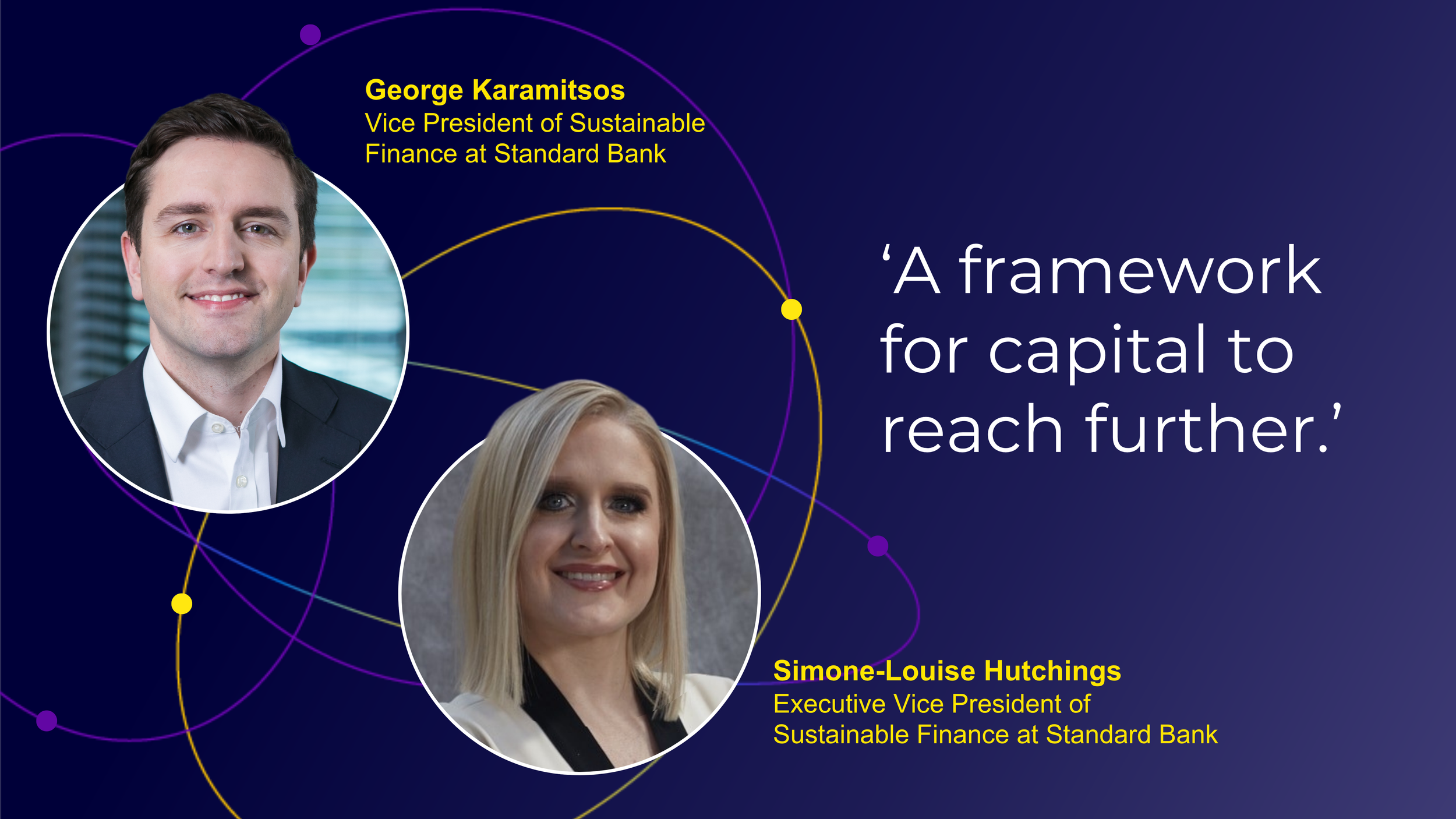
Picture quote ‘A framework for capital to reach further.’
Across Africa, there is no shortage of entrepreneurial energy. People are building businesses, supporting families and creating employment, often with remarkably little capital. What is in short supply is access: access to regulated financial products, responsible credit and the working capital needed to turn economic activity into sustainable growth.
At the same time, global investors, development finance institutions and banks are actively looking for opportunities that can deliver measurable social impact. The challenge is creating a credible and transparent route through which that capital can reach underserved customers efficiently and responsibly.
This is the gap that JUMO’s new Social Finance Framework is designed to address.
Developed in collaboration with Standard Bank’s Sustainable Finance team, the Framework provides a structure through which JUMO can raise social financing, including social loans and social bonds, to support financially inclusive lending across Africa. It is aligned with the International Capital Market Association’s Social Bond Principles and the Loan Market Association’s Social Loan Principles, and has received a positive second-party opinion from Endiligence.
For us, the Framework is about much more than a single financing transaction. It establishes a long-term platform through which institutional capital can be connected to meaningful economic opportunity.
Giving capital confidence
Institutional investors need more than a compelling impact story. They need clarity on how their capital will be deployed, which activities will qualify for funding, how proceeds will be governed and how results will be measured and reported.
The Framework provides that structure. It sets out:
The eligible social activities that financing may support
The populations those activities are intended to reach
The process for evaluating and selecting eligible social assets
The governance and management of proceeds
The allocation and impact reporting investors can expect
These measures give investors a consistent way to assess how social financing is being used. They also create the transparency needed to demonstrate that capital is reaching eligible activities and contributing to defined social outcomes with impact.
That matters because credibility is essential to mobilising sustainable finance at scale. A clear framework allows global investors, impact funds, DFIs and banks to participate with greater confidence.
Taking inclusion to scale
JUMO’s banking technology platform connects financial institutions and mobile network operators with customers who are often difficult to reach through traditional banking infrastructure. Using mobile technology, data and AI-powered credit assessment, the platform enables people to access regulated financial products without needing to visit a bank branch or provide the conventional documentation and collateral they may not have.
The scale already achieved is significant. JUMO has facilitated more than US$11 billion in disbursements through roughly 320 million individual loans across nine African markets. This creates a multi-billion-dollar opportunity for investors seeking both scale and measurable social impact.
Under the Framework, social financing can support activities, including:
Financing for microenterprises and SMEs
Employment generation
Economic empowerment
Access to responsible digital financial services
The intended beneficiaries include women, young people, rural communities, low-income individuals and populations that remain underserved by conventional financial systems.
Behind these categories are real people using modest amounts of capital to buy stock, keep a small business trading, manage an unexpected expense or begin building a formal credit profile. When funding reaches these customers responsibly, its value extends beyond the initial loan: it can strengthen household resilience, support enterprise growth and contribute to economic activity in local communities.
Building on global standards
Alignment with internationally recognised principles provides a common language through which borrowers, issuers, investors and lenders can assess social finance.
By aligning the Framework with established social bond and social loan principles, JUMO has embedded recognised requirements for the use of proceeds, project evaluation, management of funds and reporting. The positive second-party opinion from Endiligence provides additional external assurance regarding that alignment.
This is especially important in emerging markets, where investors may recognise the scale of the opportunity but be less familiar with the underlying customers, technology or lending environment. International standards help translate a proven operating model into a structure that sustainable finance markets understand.
Responsible finance must also remain responsible at the customer level. JUMO has been B Corp certified since 2022 and achieved a 92.2% customer-protection score in an independent Cerise+SPTF assessment. It was the first company assessed against the organisation’s new Digital Financial Services Standards.
These credentials strengthen the foundation on which the Framework rests: social impact cannot be measured only by how much capital is deployed, but also by how customers are treated and whether the products reaching them are transparent, appropriate and designed to create value.
Creating a repeatable platform
One of the Framework’s most important features is its repeatability.
Rather than rebuilding the eligibility, governance and reporting architecture for each financing exercise, JUMO can use the Framework to support future social loans, bonds and other qualifying instruments across the various countries where JUMO operates. This can make subsequent fundraising more efficient and create a consistent basis for engagement with sustainable finance investors.
That continuity is vital. Financial inclusion cannot be achieved through sporadic pools of capital. It requires dependable funding that can expand alongside customer demand, enter new markets and support a wider choice of products. We therefore see the Framework as infrastructure: not a once-off transaction document, but a platform for sustainable funding over time.
Connecting capital and opportunity
The Framework also represents an important evolution in how JUMO can be understood by the capital markets. JUMO is not simply a fintech lender. It is a banking technology platform capable of connecting regulated financial institutions and pools of capital with customers at a scale traditional infrastructure has struggled to reach.
That combination of technology, local partnerships, governance and measurable impact creates an opportunity to direct capital towards inclusive growth without losing the discipline institutional investors require.
The Social Finance Framework creates a credible bridge between pools of institutional capital and millions of people and businesses whose economic potential has been constrained by limited access to formal finance.
Our role at Standard Bank is to help build that bridge: bringing sustainable finance expertise and an understanding of African markets together with JUMO’s technology, data and distribution capabilities.
The opportunity is substantial. The platform is proven. The Framework now gives social-impact investors a transparent and repeatable way to participate. Capital can reach further. And when it does, it can unlock opportunity at a scale that matters.
Connect with us
To continue the conversation about sustainable finance and financial inclusion in Africa, connect with George Karamitsos on LinkedIn and Simone-Louise Hutchings on LinkedIn.