
The DRC at a Crossroads: Critical Minerals, US Engagement, and a Changing Risk Profile
By Joshua Walker, Program Director of the Congo Research Group, New York University
The Democratic Republic of the Congo or DRC—a country roughly the size of the United States east of the Mississippi river or Western Europe—has recently started showing up on the radar of US investors. Its abundance of critical minerals and rare earth elements, including copper, cobalt, tin, tantalum, tungsten, and gold have made it an important site on the African continent. Congo currently supplies approximately 75% of the world’s cobalt (critical to making batteries, among other things), 40% of the world’s coltan (used to make capacitors in most electronics), and 11-13% of the world’s copper.
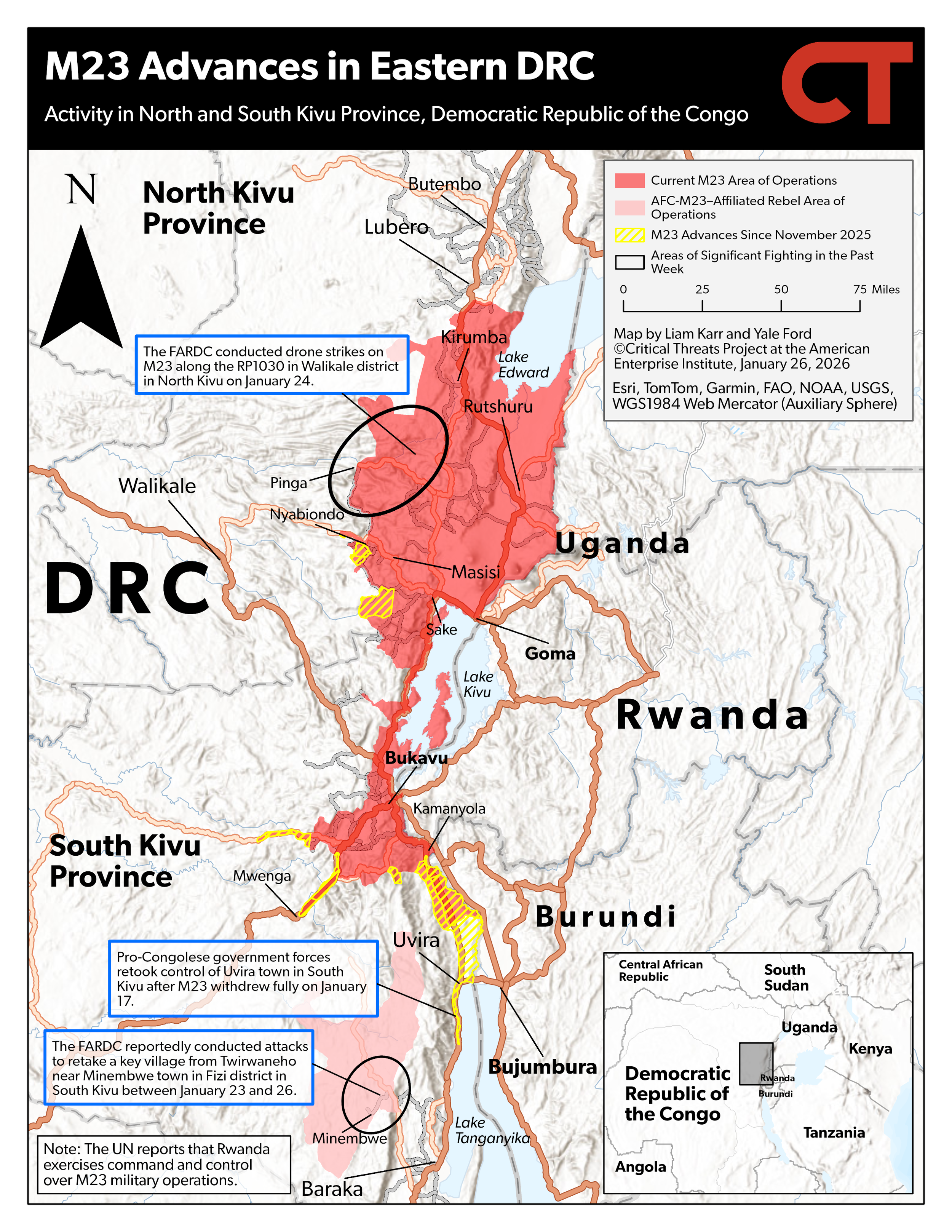
Areas under control of the M23. Credit: Critical Threats Project at the American Enterprise Institute, January 26, 2026
The DRC undoubtedly has a troubled past that has contributed to its negative reputation for investment, historically: from the corruption of the Mobutu dictatorship in the 1970s and 80s to the first and second Congo Wars of the late 90s and early 2000s. But things are arguably looking up, from a macroeconomic perspective: in 2021, the IMF resumed support to the DRC under a three-year program that disbursed approximately $1.2 billion; in 2025, it began a new three-year extended credit facility with the DRC. Importantly, the existence of the IMF program encourages the world’s largest DFI’s to lend to DRC too, so the effect becomes much greater than simply the $1.2 billion from the IMF. The IMF program is also a significant confidence builder for investors.
And the conflict in the country’s east, while significant, is also quite localized—it covers a relatively small geographic area in a big country. In June 2025, the Trump administration brokered, and subsequently hosted the signing, of a peace deal between Rwanda and the DRC—the eastern Congo has seen on-off conflict go on for over 30 years, albeit with ebbs and flows. While there are multiple armed groups in the country’s east, the conflict that has had the greatest geopolitical impact on the is that involving the March 23rd Movement or M23, and its political umbrella group, the Alliance Fleuve Congo or Congo River Alliance, known by its French acronym, AFC.
The DRC, backed by evidence from a UN expert panel, accuses Rwanda of supporting the M23 & AFC rebellion, which progressively took over territory in North and South Kivu provinces in the country’s east—most importantly, it expanded and took the city of Goma, with approximately two million residents and Bukavu, with over a million—the two largest cities in that part of the country. Rwanda claims that it maintains “defensive measures,” citing its own security concerns—mainly the continued presence in Eastern Congo of the FDLR, the remnants of the former Rwandan genocidaires. Many observers, however, view “defensive measures” as a euphemism for robust support to the M23 by Rwanda to exert a degree of control over part of Congolese territory and its resources. In a statement to the House Foreign Affairs Committee on January 22, 2026, the Rwandan ambassador to the US admitted that they “engage in security coordination” with the M23/AFC. However, Rwandan support for the M23 and its predecessors has been an open secret for decades.
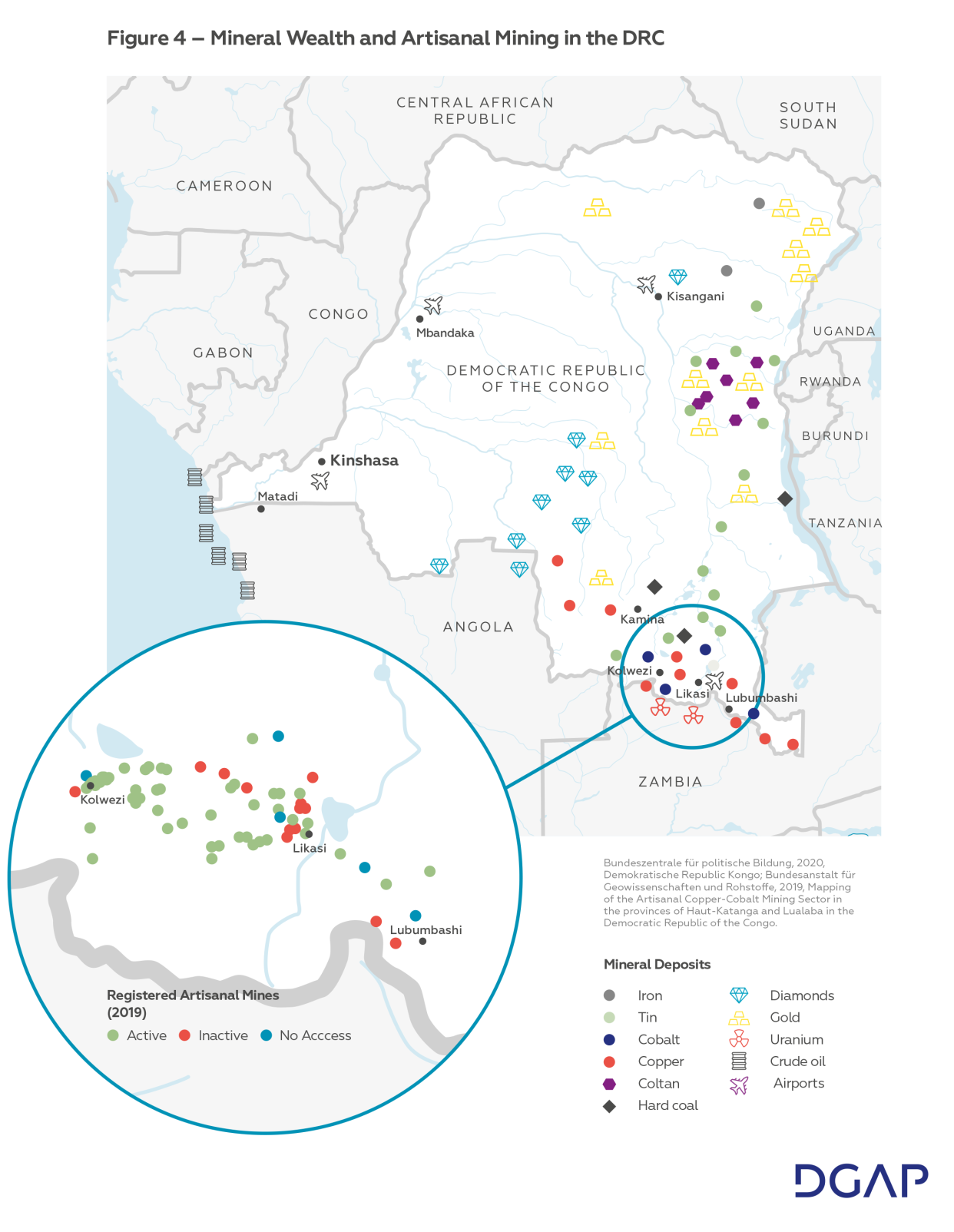
Concentrations of mineral deposits in the DRC. Credit: German Council on Foreign Relations, “Climate and Environmental Security in the Democratic Republic of the Congo,” April 3, 2023.
The eastern parts of the DRC (the provinces of North and South Kivu, and Ituri) have many mines (said to be over 5,000) but the vast majority of them are artisanal and they lack major investment. Part of the reason that the mines are artisanal is that large-scale international investors have not invested there. The eastern DRC therefore contributes relatively little to the country’s GDP and the state coffers. True peace in the region will therefore be transformational.
While peace remains possible, but still elusive, the Trump administration is pressing forward with a number of related initiatives in the DRC, particularly focused on accessing its critical minerals and rare earths. During a visit to Washington in December of last year, presidents Félix Tshisekedi of the DRC and Paul Kagame of Rwanda adopted a US-brokered Regional Economic Integration Framework (REIF) between their two countries, designed to promote economic integration as a stabilizing element and bulwark against future conflict. The REIF is also designed to foster a favorable climate for US investment in key sectors in the region, including energy, mineral supply chains, infrastructure, national parks management and tourism, and public health and safety.
The US also signed a strategic partnership agreement with the DRC in December, which is designed to improve governance in the Congo’s mining sector and give “US persons and aligned persons” a right of first offer for projects that are part of a newly established Strategic Asset Reserve (SAR)—the DRC sent a first list of state-owned assets to the US government this month that includes manganese, copper-cobalt, lithium, and gold projects.
At the same time, under the previous administration, the US began support, which continues today, for a rail link between southeastern DRC, in the heart of the Copperbelt, with the Angolan port of Lobito on the Atlantic Ocean—the Lobito Corridor. The US International Development Finance Corporation has already committed over $500 million for the rehabilitation of the railway.
The DRC’s demographics—it has an estimated 110 million inhabitants—and geography—it is approximately 2.3 million km2 in area, the second largest country in Africa, with few good roads—make it a vast country with enormous regional variation.
As the demand for critical minerals and other resources grows, the DRC will become an increasingly important investment destination in Africa. Understanding the complexities and opportunities of this huge country, in all its regional variations, will be important for investors and others. The challenge—which can be met—is to ensure that those resources generate tangible benefits for all parties.
Watch the full session of our recently hosted webinar, ‘The DRC in Focus: Geopolitics, Political Economy, and the Evolving Investment Landscape’